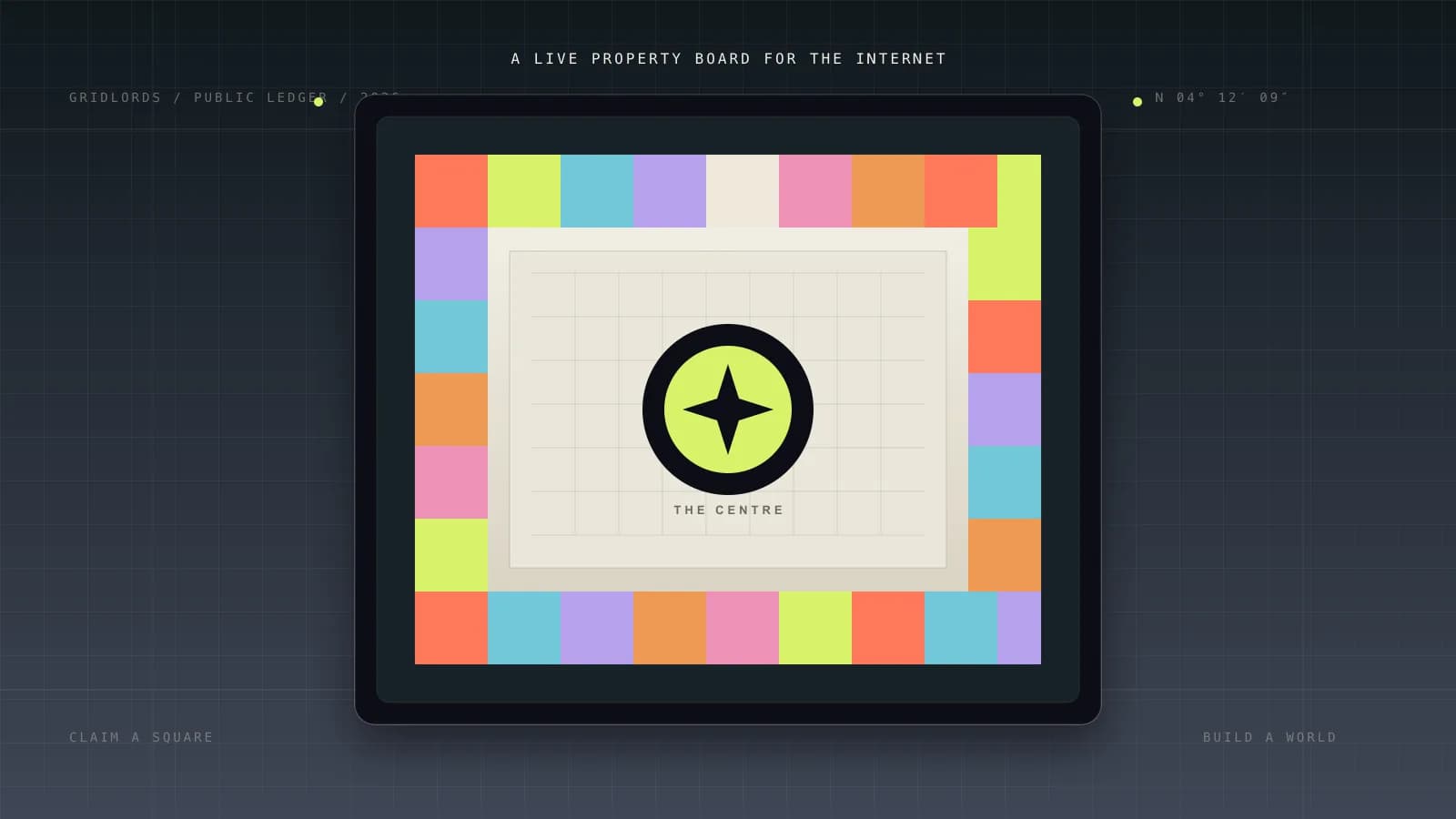
Gridlords is a live property board for the internet. You can browse the board, roll to move around it, claim an open square, and bid against other players for a place that already has an owner. A website can appear on the board through its favicon or a custom logo. The board keeps the activity in public, so the thing you claimed is part of a shared page rather than a private dashboard.
That is the short version. The longer version starts with a question: what would happen if a website felt less like a page you visit and more like a place you can point to?
A board you can actually see
Most online ownership is hidden behind an account screen. You own a domain, a handle, or a subscription, but other people rarely see the ownership itself. Gridlords puts that part on the page. The board has 32 positions, public activity, a leaderboard, an open Centre auction, and a list of squares that are still available.
The board is also deliberately small. A limited number of squares is easier to understand than an endless map, and it gives each position a little context. You can tell when a square is open, when its price is rising, and when someone has put a website there. The public feed records the movement around it.
The board is part of the product
A normal landing page tries to move you quickly toward a button. Gridlords gives you a page worth looking at before you decide what to do. The side panels show the latest market activity and the people holding squares. The centre of the board holds the Centre auction and two smaller deck sponsorship slots. The right rail shows what is still available.
Those details are not decoration. They answer the questions people have when they arrive: Is anything happening here? Are other websites already on the board? Can I find an open square? A public board needs those answers in the room, so the page puts them beside the thing being claimed.
Gridlords is a game board first. The money changes who controls a square, not what that square is worth outside the game.
How Gridlords works
You do not need to understand a complicated economy before you start. The main loop is visible on the board.
- Browse the board.Look at the live feed, the current leaders, the Centre auction, and the squares that are open.
- Sign in when you want to play.Guests can look around. Google sign-in connects a player to their position, balance, claims, and bids.
- Roll and move.The board uses a server-recorded dice roll, so your move becomes part of the public game state.
- Claim or bid.An open square has an opening price. An occupied square can receive a higher bid, which may replace the current claim after payment is confirmed.
Why put a website on a square?
A square gives a website a physical-looking place in the board. It has a position, a price, a visible owner, and a logo that people can recognize at a glance. When a visitor selects it, the board can show the website and the claim details. That is a different experience from buying a banner that disappears into the next page refresh.
The logo part is simple on purpose. Enter a domain and Gridlords looks for its public favicon. If the favicon is not right for the board, the owner can upload a custom image instead. The result is a small mark on the board, not a new profile to maintain.
This makes a square useful for a personal project, an indie product, a studio, a newsletter, or a company that wants to be seen in a place people are exploring for fun. It is a small placement with a clear story: this site is here because someone chose this square.
What a square holds
Every claim has a square, an owner, an amount, and a timestamp. When a website is attached, the board stores its normalized address and the logo source used for the display. That lets the board keep showing a recognizable mark even when the live feed has moved on to a newer event.
The visible part stays intentionally small. A visitor should be able to scan the board without reading a sales page on every tile. Selecting a square opens the details when someone wants to know more. It is closer to seeing a name on a street map than reading a full company profile.
Is this digital real estate?
People often use "digital real estate" to describe websites, domains, social accounts, virtual land, or paid space on a public page. Gridlords borrows the familiar language of property, but the rules are narrower and easier to check. A square is a game position and a paid placement on the Gridlords board. It is not a domain name, an NFT, a security, or a promise of future income.
The closest comparison is probably a public game board crossed with a small ad space. The value comes from the experience around the square: people can visit the board, watch activity happen, and see who is currently holding a position. If a higher verified bid replaces a claim, that change is part of the game.
Why keep the rules simple?
The board has enough moving parts already. There are prices, bids, positions, and a public feed. Adding a complicated points economy would make the first visit harder and would blur the reason someone wants a square in the first place.
Simple rules also make the public state easier to trust. An open square has an opening price. A bid has to beat the current amount. A paid claim becomes active after the payment provider confirms it. Those rules fit on the page and give every player the same starting point.
What makes Gridlords different from a normal browser game?
In a normal browser game, the board exists to move players toward a result. In Gridlords, the board is also the thing people are looking at. It has a public market, changing ownership, recognizable websites, and a history of recent moves. You can play for the position, browse for the names, or do both at once.
The pace is part of the design. You can visit for a minute, inspect a square, and leave. You can come back later to see if the board changed. The board does not need a ten-minute tutorial before it makes sense. The coloured squares, the price, the live feed, and the Centre make the rules visible as you go.
Who is Gridlords for?
It is for people who like small internet experiments, public leaderboards, and games with a little social friction. It is also for people building on the web who want a memorable place to put a project name or logo.
You do not have to be a serious gamer. You do not have to buy a square. Browsing the board is free, and the public state is there for anyone to inspect. The paid parts are optional and clearly marked. If you do decide to claim a square or place a bid, read the current price and the terms before you check out.
A place for small launches
A new product often has a name before it has an audience. A small website can be technically ready and still feel invisible. Putting that site on a shared board gives it a simple introduction. Someone can ask what the logo is, select the square, and follow the link. That is a better conversation than another anonymous impression in a banner slot.
The same idea works for a newsletter, a side project, or a community that wants a public marker. The board does not decide whether the project is important. It gives the project a place where other people can notice it.
What Gridlords is not
Gridlords does not turn a board position into cash. Board cash, points, claims, and bids have no cash value outside the service. A square can be replaced by a higher verified bid under the board rules, and a payment activates a claim only after confirmation.
That boundary matters. The fun comes from a visible, changing board and the small argument over where a website belongs. It does not come from promising that a square will appreciate or pay you back.
How to try it
Open the live board and take a minute to look around. Check the unclaimed list. Select a few squares. Watch the feed. If you want to roll, bid, or claim a square, sign in first. You can also read the terms of service before making a purchase.
Gridlords is still a small board. That is part of the point. Every new website changes the view, and every new bid gives the public page something else to watch. Pick a corner, or just see who got there first.
This article describes the current Gridlords board and may change as the game rules and sponsorship options develop. Last updated September 10, 2026.